Holomorphic function
Holomorphic functions[edit]
Complex functions that are differentiable at every point of an open subset of the complex plane are said to be holomorphic on . In the context of complex analysis, the derivative of at is defined to be[1]


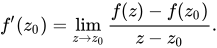
Superficially, this definition is formally analogous to that of the derivative of a real function. However, complex derivatives and differentiable functions behave in significantly different ways compared to their real counterparts. In particular, for this limit to exist, the value of the difference quotient must approach the same complex number, regardless of the manner in which we approach in the complex plane. Consequently, complex differentiability has much stronger implications than real differentiability. For instance, holomorphic functions are infinitely differentiable, whereas the existence of the nth derivative need not imply the existence of the (n + 1)th derivative for real functions. Furthermore, all holomorphic functions satisfy the stronger condition of analyticity, meaning that the function is, at every point in its domain, locally given by a convergent power series. In essence, this means that functions holomorphic on can be approximated arbitrarily well by polynomials in some neighborhood of every point in . This stands in sharp contrast to differentiable real functions; there are infinitely differentiable real functions that are nowhere analytic; see Non-analytic smooth function § A smooth function which is nowhere real analytic.
Most elementary functions, including the exponential function, the trigonometric functions, and all polynomial functions, extended appropriately to complex arguments as functions , are holomorphic over the entire complex plane, making them entire functions, while rational functions , where p and q are polynomials, are holomorphic on domains that exclude points where q is zero. Such functions that are holomorphic everywhere except a set of isolated points are known as meromorphic functions. On the other hand, the functions , , and are not holomorphic anywhere on the complex plane, as can be shown by their failure to satisfy the Cauchy–Riemann conditions (see below).


An important property of holomorphic functions is the relationship between the partial derivatives of their real and imaginary components, known as the Cauchy–Riemann conditions. If , defined by , where , is holomorphic on a region , then for all ,





In terms of the real and imaginary parts of the function, u and v, this is equivalent to the pair of equations and , where the subscripts indicate partial differentiation. However, the Cauchy–Riemann conditions do not characterize holomorphic functions, without additional continuity conditions (see Looman–Menchoff theorem).


Holomorphic functions exhibit some remarkable features. For instance, Picard's theorem asserts that the range of an entire function can take only three possible forms: , , or for some . In other words, if two distinct complex numbers and are not in the range of an entire function , then is a constant function. Moreover, a holomorphic function on a connected open set is determined by its restriction to any nonempty open subset.


Conformal map[edit]
Conformal mapping are locally invertible complex analytic function in two dimensions for orientation preservation.

Comments
Post a Comment