Complex analysis
Complex analysis
 | This article includes a list of general references, but it lacks sufficient corresponding inline citations. (March 2021) |
| Mathematical analysis → Complex analysis |
| Complex analysis |
|---|
 |
| Complex numbers |
| Complex functions |
| Basic Theory |
| Geometric function theory |
| People |

Complex analysis, traditionally known as the theory of functions of a complex variable, is the branch of mathematical analysis that investigates functions of complex numbers. It is helpful in many branches of mathematics, including algebraic geometry, number theory, analytic combinatorics, applied mathematics; as well as in physics, including the branches of hydrodynamics, thermodynamics, and particularly quantum mechanics. By extension, use of complex analysis also has applications in engineering fields such as nuclear, aerospace, mechanical and electrical engineering.[citation needed]
As a differentiable function of a complex variable is equal to its Taylor series (that is, it is analytic), complex analysis is particularly concerned with analytic functions of a complex variable (that is, holomorphic functions).
History[edit]

Complex analysis is one of the classical branches in mathematics, with roots in the 18th century and just prior. Important mathematicians associated with complex numbers include Euler, Gauss, Riemann, Cauchy, Weierstrass, and many more in the 20th century. Complex analysis, in particular the theory of conformal mappings, has many physical applications and is also used throughout analytic number theory. In modern times, it has become very popular through a new boost from complex dynamics and the pictures of fractals produced by iterating holomorphic functions. Another important application of complex analysis is in string theory which examines conformal invariants in quantum field theory.
Complex functions[edit]

A complex function is a function from complex numbers to complex numbers. In other words, it is a function that has a subset of the complex numbers as a domain and the complex numbers as a codomain. Complex functions are generally supposed to have a domain that contains a nonempty open subset of the complex plane.
For any complex function, the values from the domain and their images in the range may be separated into real and imaginary parts:



where are all real-valued.

In other words, a complex function may be decomposed into

- and

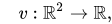
i.e., into two real-valued functions (, ) of two real variables (, ).


Similarly, any complex-valued function f on an arbitrary set X can be considered as an ordered pair of two real-valued functions: (Re f, Im f) or, alternatively, as a vector-valued function from X into

Some properties of complex-valued functions (such as continuity) are nothing more than the corresponding properties of vector valued functions of two real variables. Other concepts of complex analysis, such as differentiability, are direct generalizations of the similar concepts for real functions, but may have very different properties. In particular, every differentiable complex function is analytic (see next section), and two differentiable functions that are equal in a neighborhood of a point are equal on the intersection of their domain (if the domains are connected). The latter property is the basis of the principle of analytic continuation which allows extending every real analytic function in a unique way for getting a complex analytic function whose domain is the whole complex plane with a finite number of curve arcs removed. Many basic and special complex functions are defined in this way, including the complex exponential function, complex logarithm functions, and trigonometric functions.

Comments
Post a Comment